Customers & Business
The Comprehensive Guide to Healthcare Interoperability


last updated Updated
August 20, 2026
8 min read

 Customers & Business
Managing patient information has grown increasingly complex. Healthcare practices face massive volumes of clinical data, evolving compliance mandates, and even security vulnerabilities tied to legacy applications and workflows. Electronic Health Record (EHR) systems were supposed to help solve this challenge, and adoption across the industry has now reached significant levels. More than 99% of hospitals have implemented an EHR, and the vast majority of medical offices have done so as well. However, despite this digital transformation, patient information often remains locked inside clinical silos, disrupting care coordination and complicating care transitions.
Still healthcare interoperability remains a critical problem, and the impact is significant. A CRICO Strategies analysis of 23,000 malpractice claims found that communication failures contributed to nearly 2,000 preventable deaths and $1.7 billion in malpractice costs. A study by the Joint Commission reported that communication failures during handovers are a contributing factor in up to 80% of serious medical errors.
This comprehensive guide explores the current realities of healthcare interoperability, the often-missing infrastructure required to connect modern medical networks, and how you can eliminate administrative inefficiencies to drive safer patient care.
The Current State of Healthcare Interoperability
The modern medical landscape presents a profound interoperability in healthcare paradox. The overwhelming majority of acute care hospitals and office-based providers have successfully adopted electronic records. Yet, because these networks operate on distinct platforms, clinical data exchange remains severely restricted.
For example, more than two-thirds of substance use and mental health treatment facilities today use EHRs, but only one in five have systems that enable healthcare data exchange capabilities with HIEs. About 25% of practices still rely on paper charts. This technological divide has kept traditional communication methods deeply entrenched across clinical operations. Rather than disappearing, legacy workflows have adapted, leaving healthcare organizations to manage an overwhelming influx of unstructured data.
The Persistence of Faxing
In high-volume settings like hospitals, 45% of all inbound documents still arrive via fax due to a lack of centralization across the healthcare ecosystem. Clinics, residential treatment centers, and nursing facilities deal with even higher volumes.
The Integration Shortfall
24% of medical practices report that they operate without integrated cloud fax capabilities that work alongside their electronic health record (EHR) or practice management (PM) workflows. According to a recent survey of healthcare CIOs and digital health leaders conducted by eFax®, nearly half of providers still rely on manual, paper-dependent processes to share patient data with facilities lacking integrated electronic health records.
This is especially challenging for smaller and specialized practices. Learn more in our blog, Left Behind: Why Small Town Americans Are Waiting Longer for Healthcare.
True healthcare interoperability requires shifting away from isolated, rigid data repositories toward an open, collaborative environment. Achieving this transformation means deploying solutions that can automatically transform unstructured incoming records and transition them smoothly into your HER.
What is EHR vs. EMR?
While EHRs are designed to share data across a wider network of healthcare providers, EMR software typically locks data within a practice. This complicates healthcare data exchange even further.
Electronic Health Records (EHRs)
Designed explicitly for external data exchange, an interoperable EHR system integrates records across hospitals, laboratories, state networks, and multi-specialty clinics to give authorized teams a holistic, real-time view of a patient’s health history
Electronic Medical Records (EMRs)
An EMR functions as a digital version of a patient’s chart, capturing detailed clinical history, diagnoses, and treatments strictly within the four walls of a single practice. Because EMR platforms frequently rely on legacy tech or proprietary formats, the patient data they store is heavily siloed. Sharing data with other providers typically forces staff back into manual entry or paper workflows.
What’s the difference between EHR and EMR? Here’s a side-by-side comparison.
| Feature | EMR (Electronic Medical Record) | EHR (Electronic Health Record) |
| Clinical Scope | Limited to internal use within one practice. | Broader view across multiple organizations. |
| Data Accessibility | Confined to internal staff and legacy setups. | Secure access for authorized providers. |
| Interoperability Frameworks | Lacks external integration; relies on proprietary formats. | Built on universal standards like HL7 and FHIR. |
| Patient Engagement | Provider-focused; lacks patient-facing portals. | Patient-centric; features robust health portals. |
The Technical Building Blocks of EHR Integration
Achieving true system connectivity requires EHR integration, including automating healthcare data exchange from different software platforms. This relies on standardized protocols and cloud solutions like eFax® Unite and eFax® Clarity for handling unstructured data and intelligent data extraction.
Standardized interoperability frameworks include:
- HL7 (Health Level Seven): A widely adopted international standard that provides a common framework for structuring and exchanging clinical data across modern healthcare networks.
- FHIR (Fast Healthcare Interoperability Resources): Built by HL7, FHIR leverages modern web structures and APIs to provide modular, real-time data transmission across completely different platforms.
- C-CDA (Consolidated Clinical Document Architecture): An XML-based markup standard that provides specific templates for structuring electronic patient summaries, progress notes, discharge records, and clinical test results.
API-Based Connections
Modern cloud-based healthcare networks are actively moving away from rigid, legacy system architectures in favor of agile, cloud-based RESTful APIs that more easily extract and transmit critical data elements.
eFax Corporate®’s RESTful Fax API is designed specifically for highly-regulated industries like healthcare that demand strong encryption as well as high-volume faxing. By utilizing a secure, compliant API architecture, health systems can seamlessly embed high-volume document transmission directly into their existing EHR interfaces. This eliminates having to toggle between programs and also ensure secure, compliant data exchange.
Addressing Care Coordination Gaps
Care coordination involves managing patient care across multiple clinical settings, an effort that becomes absolutely vital when treating complex, chronic health conditions. When communication channels break down, the resulting technical gaps create immense operational and clinical liabilities.
How important is interoperability in healthcare for care coordination? A study in The American Journal of Managed Care reported that heart failure patients receiving high levels of care coordination experienced 10% fewer in readmissions, 17% lower risk of mortality, and a 16% reduction in overall healthcare costs.
While large organizations may have dedicated staff to manage care coordination, with smaller providers, that responsibility typically falls to clinicians, who are already dealing with burnout work levels in many practices.
Clinician Burnout
The lack of interoperability in healthcare systems impacts patient safety and takes an immense toll on the day-to-day well-being of the medical workforce.
Administrative gridlock consumes valuable hours, pulling staff away from patient care and forcing them to handle documentation long after their shifts have officially ended.
In athenahealth’s Physician Sentiment Survey (PSS), 93% of physicians surveyed said they feel burned out on a regular basis, spending as much as 15 hours a week working outside normal business hours. Home health care teams face immense friction, where completing a single, highly detailed Outcome and Assessment Information Set (OASIS) document can take up to three hours for a complex patient.
Referral Breakdowns
Breakdowns in managing and tracking healthcare referrals continue to be a significant issue. According to the American College of Physicians, communication issues result in nearly half of referrals not being completed. Smaller practices often lack the automated tools required to track outbound data or confirm patient scheduling. Even in larger organizations, however, EHR interoperability challenges often allow referrals to fall through the cracks.
Health Tech Inequities
A major equity gap persists in healthcare technology. While billions in federal grants under the 2009 HITECH Act provided funding to modernize health networks, the law excluded behavioral health facilities and substance use disorder (SUD) clinics from its EHR incentive programs. This left many mental health and addiction providers digitally isolated from mainstream medical systems, lacking the interoperability they needed for clinical data exchange.
While 99% of acute care hospitals operate with certified EHR platforms, more than two-thirds of mental health and substance use networks rely entirely on isolated internal software systems. 38% of state-run behavioral health centers continue to rely heavily on manual, paper-based records, leaving staff to wade through hundreds of handwritten pages during a standard patient admission.
When a behavioral health patient is transferred between facilities without structured data access, continuity of care failures can occur. Missing a single day of essential psychiatric medications due to missing charts can cause significant problems, one reason why 30-day emergency department readmission rates for adult behavioral health patients are 25% compared to just 15% for physical health patients.
Deloitte estimates the economic impact of health inequities at $320 billion annually in avoidable healthcare costs.
Building EHR Interoperability with eFax
EHR interoperability initiatives like TEFCA promote the use of advanced, raw FHIR resources to exchange clinical summaries. However, building this infrastructure independently requires extensive financial resources and specialized IT engineering that many health systems and healthcare practices simply cannot afford.
A cost-effective solution is to leverage third-party solutions that bridge this gap. For example, the Medical Group Management Association (MGMA) reports that 73% of medical groups have integrated digital fax solutions within their EHR workflows to seamlessly turn unstructured communication channels into clean, digital records.
The eFax suite of cloud-based, interoperable solutions can complement your existing software applications, optimizing your data flows and eliminating your reliance on legacy fax machines and less-than-secure analog phone lines.
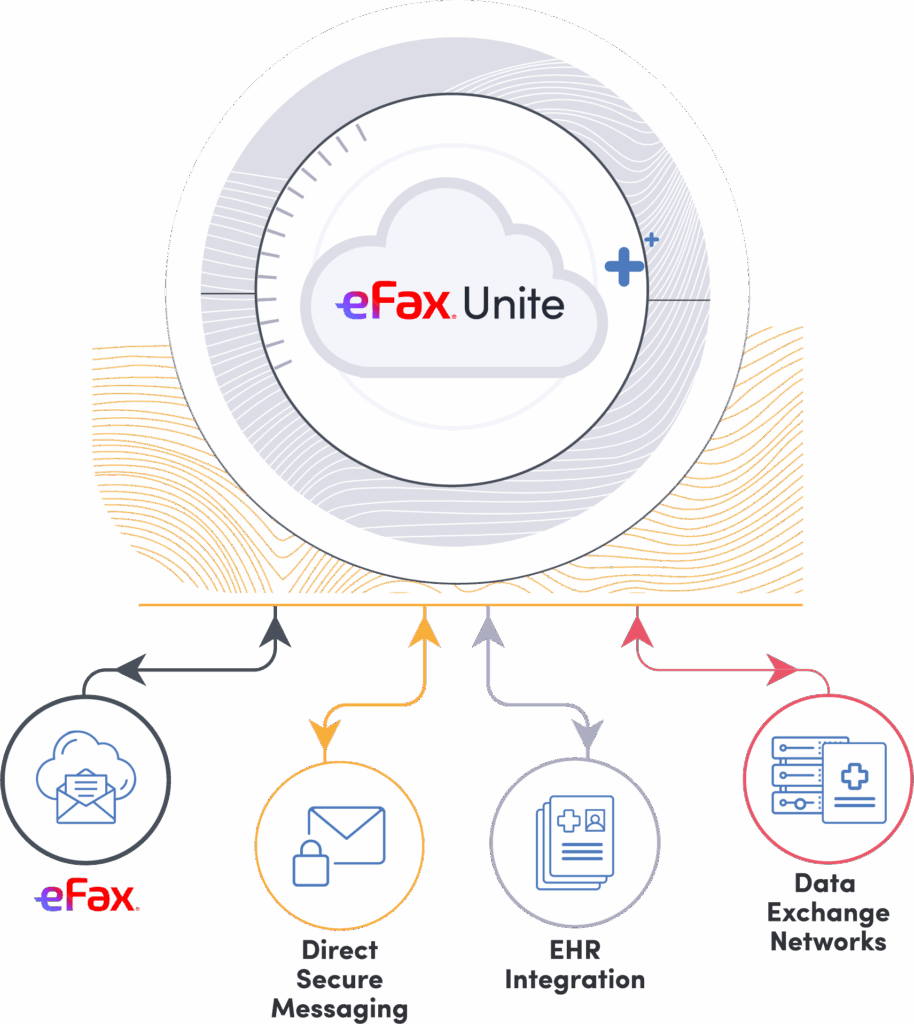
eFax® Unite: Your Comprehensive Interoperability Hub
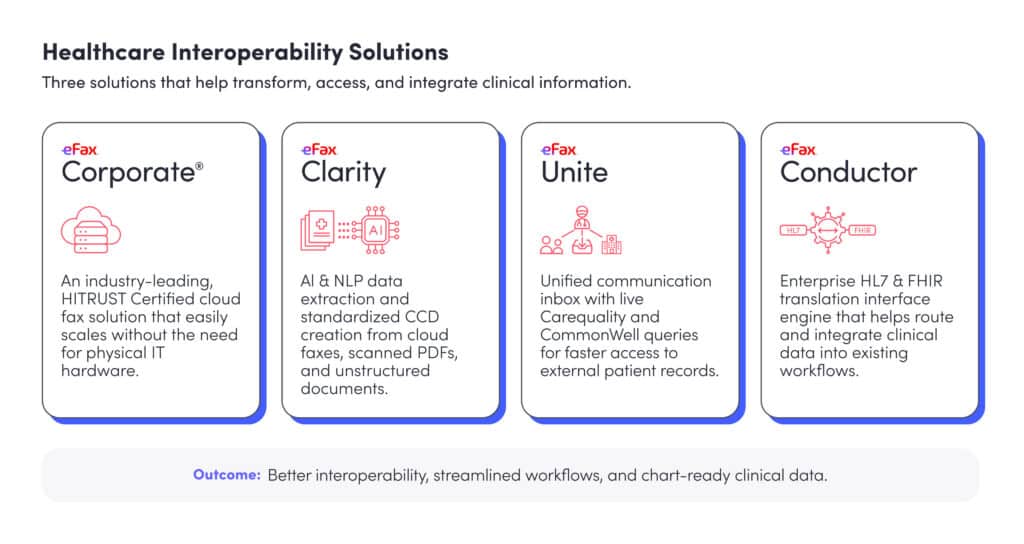
eFax® Unite enables healthcare interoperability with streamlined clinical workflows in an easy-to-use platform that improves communication and connectivity through the continuum of care. By integrating eFax Corporate® with eFax® Unite, healthcare professionals can streamline communication, ensuring data fluidity and digital interoperability.
Unite integrates out of the box with specialized electronic platforms like PointClickCare and others. This capability allows post-acute care teams to run real-time patient searches, edit incoming files to remove duplicate pages, and download incoming clinical records straight to a resident’s digital chart without manual re-keying.
The platform connects users directly to health information exchanges, including Carequality and the CommonWell Health Alliance. This streamlines independent practice and behavioral health workflows, enabling them to query national networks for patient data, track outbound referrals, and verify if a specialized consulting physician has officially viewed or updated a care record.
eFax® Clarity: AI-Powered Unstructured Data Extraction
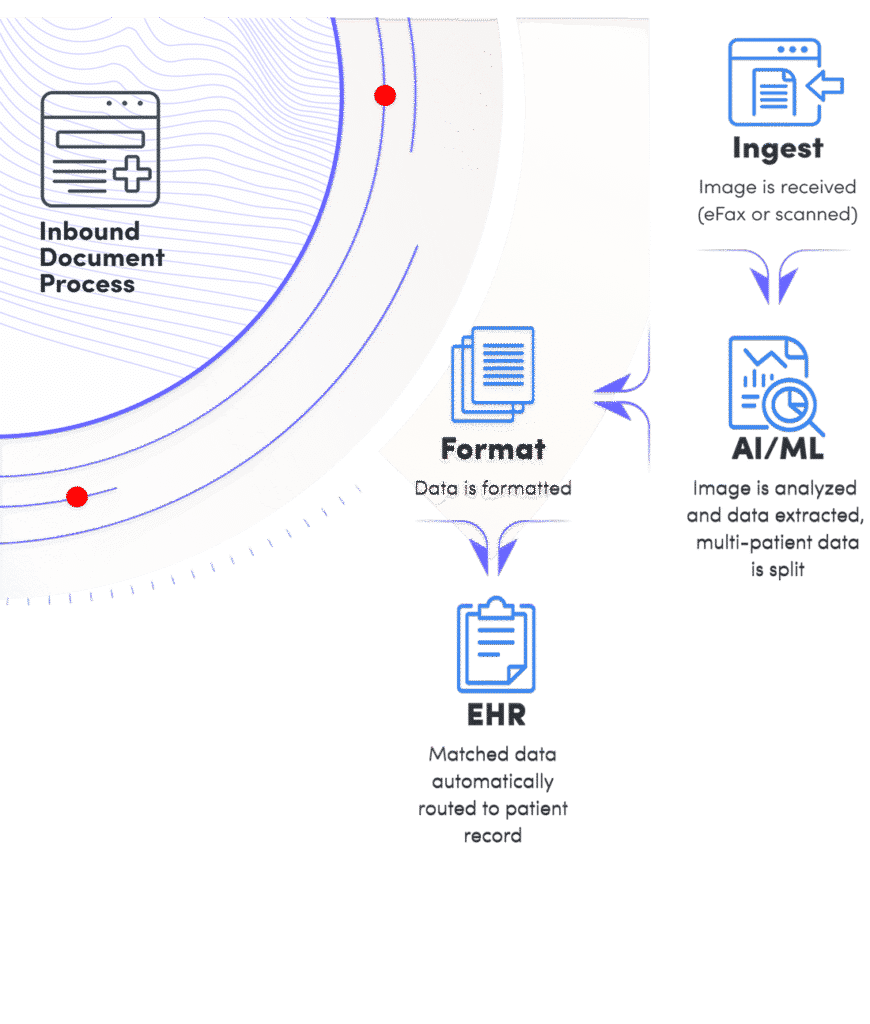
eFax® Clarity targets unstructured data. Operating as an advanced data intelligence tool, Clarity leverages AI and Natural Language Processing (NLP) to read and interpret the clinical context within incoming referrals, unstructured text PDFs, and handwritten notes.
Clarity intelligently extracts unstructured demographic details, diagnoses, and medical lists, automatically converting them into a highly structured, standardized Continuity of Care Document (CCD). This structured file maps directly to your clinical workflows, allowing seamless ingestion into your core EHR and helps practices achieve an automated 70% operational efficiency gain over manual administrative data entry.
eFax® Conductor: The Enterprise Interoperability Interface Engine
The eFax® Conductor interface engine and healthcare interoperability platform provides seamless integration that supports all the latest standards for connectivity and data formats (API/FHIR, Web Service). For enterprise-level hospital networks, large multi-site clinics, and diagnostics laboratories managing massive data pipelines, Conductor serves as a high-powered data router and translator.
Conductor absorbs legacy text documents, secure FTP files, and cloud faxes, translating them into standardized HL7 formats or modern FHIR resources. By serving as a technical translator, Conductor ensures that older legacy endpoints and EHR systems communicate seamlessly, sharing records across your entire tech stack.
Improving Healthcare Interoperability
If every healthcare system and practice used the same system, true healthcare interoperability would be easy, but that’s not the case. The solution is building smart, secure bridges between the different systems that are in place.
By combining digital cloud faxing with automated AI data extraction and secure messaging networks, the eFax suite of solutions enables healthcare practices to break out of traditional information silos. These workflows protect private data, minimize life-threatening clinical errors, reduce pajama time, and — most importantly — return the focus to patient outcomes rather than administrative tasks.
Discover how eFax can transform your practice by booking a personalized demo today.
FAQ’s
An EHR is a digital platform designed to manage patient data electronically, using universal data standards to securely share real-time clinical data across providers.
An EMR is a localized digital chart used primarily for internal documentation within a single practice. EHRs are built to enable healthcare interoperability, allowing secure patient data exchange.
Healthcare interoperability is difficult because medical data is stored across hundreds of incompatible systems built by competing vendors, and not every practice has adopted current technology. eFax offers a suite of tools to help you bridge this gap and improve healthcare interoperability and cloud fax efficiency.
Agile, cloud-based RESTful APIs replace older, rigid architectures by establishing a clean, secure channel to extract and transmit specific data elements in real time. These API connections make it easy to link communication tools directly into core EHR dashboards, streamlining administrative workflows.
eFax® Clarity uses Artificial Intelligence and Natural Language Processing (NLP) to read unstructured files, like scanned PDFs and handwritten faxes. It extracts the underlying clinical content and formats it into a standardized Continuity of Care Document (CCD) that can be instantly consumed by an EHR, bypassing manual entry.
eFax® Unite connects SNFs to communication exchanges, including statewide HIEs, referral networks, and the providers within those networks. SNF staff can send patient info queries effortlessly through Carequality thanks to built-in connections with CommonWell Health Alliance, ACOs and other data exchange networks.
Yes. Practices do not need to undergo an expensive software upgrade to ensure compliance. By deploying secure, cloud-based communication tools that feature advanced data encryption, comprehensive audit trails, and secure server storage, teams can fully address operational security risks. eFax offers cost-effective solutions for smaller practices and enterprise health systems.