Healthcare & Interoperability
How eFax® Conductor, an Intelligent Integration Engine, Resolves Workflow Challenges


last updated Updated
October 15, 2026
5 min read

 Healthcare & Interoperability
One simple tool to solve
the whole interoperability mess
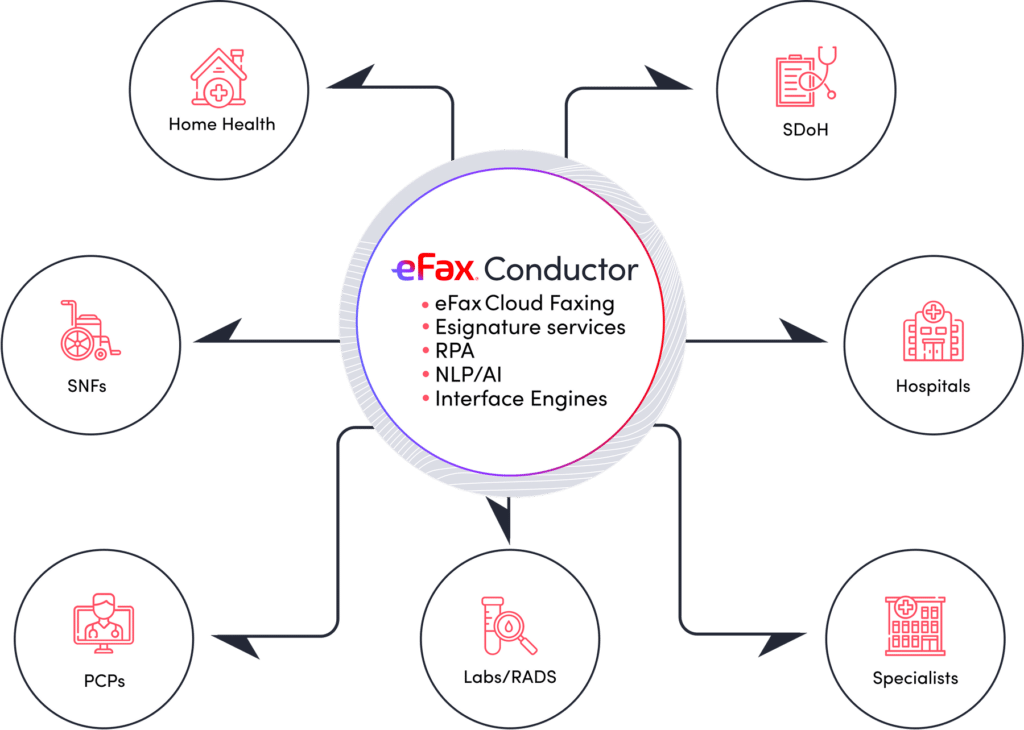
The eFax® Conductor integration engine can help your organization take significant steps to streamline and automate just about every one of your staff’s regular data exchange workflows — to save your organization time and money and help you deliver better patient care.
Workflow automation, within the realm of interoperability, involves leveraging technology to automate and optimize operations within healthcare facilities. This encompasses a wide spectrum of tasks, such as appointment scheduling, patient record management, staff activities coordination, roster management, billing processes, healthcare insurance handling, and various other operational aspects.
The primary objective is to boost efficiency, minimize errors, and elevate the quality of patient care. The benefits of implementing workflow automation in healthcare encompass heightened accuracy, improved communication channels for better patient care, cost savings, streamlined data management, enhanced compliance adherence, and increased levels of patient satisfaction.
Workflow challenge #1: The technical barrier of complex data standards
While the healthcare industry introduced standards like JSON, XML, FHIR, and C-CDA to improve data sharing, these formats often create a technical wall for average staff members. Traditionally, bridging the gap between these disparate standards required specialized coding knowledge and constant developer oversight to maintain.
If your organization is like most, your staff probably finds itself jumping back and forth among these standards to exchange patient data with physicians, pharmacies, HIEs, and other providers.
How eFax® Conductor solves this challenge
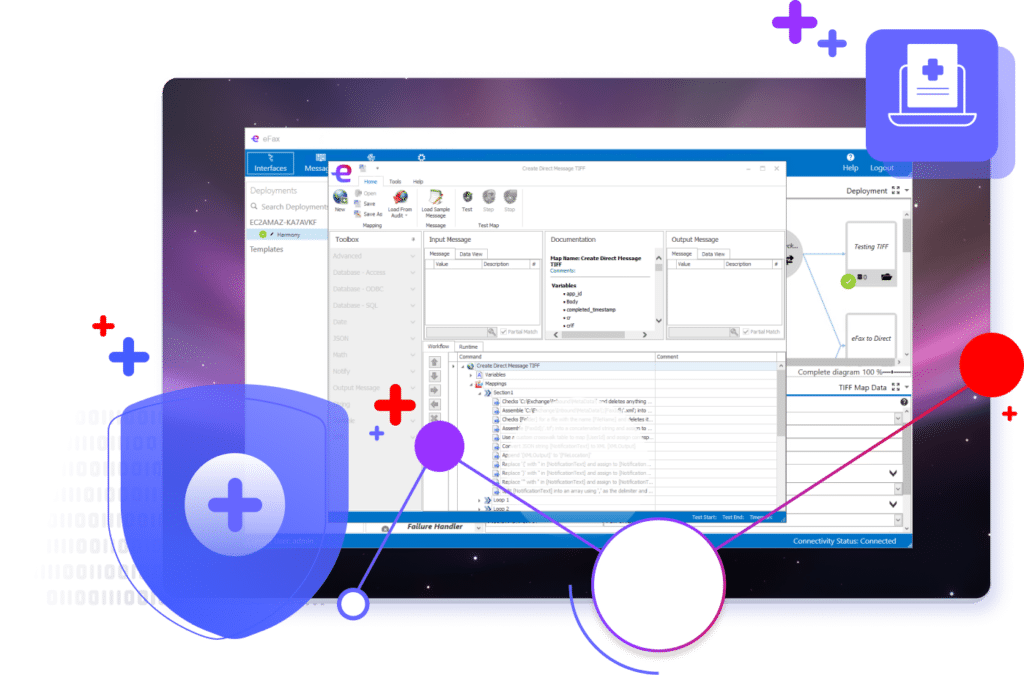
Instead of requiring a dedicated IT team to write custom scripts for every data exchange, eFax® Conductor provides a no-code environment that runs in the background of your IT infrastructure, providing:
- Simplified Format Conversion: Staff can easily convert patient data from many different formats into the specific language required for the next action without needing to analyze the underlying code.
- Reduced Maintenance Burden: Because the system normalizes data across disparate systems, your organization better maintain the mess of updating individual codebases every time a data standard evolves.
- Accessible Automation: When paired with eFax®’s Intelligent Document Processing tool – eFax® Clarity – even unstructured data like handwritten notes or PDFs can be interpreted to help support the ingestion into your EHR and streamline the process to provide efficiency.
Workflow challenge #2: Too many data exchange protocols
Another enormous challenge facing most hospitals and health systems is the need to maintain several different communication tools and channels in order to exchange important patient data with third parties across the healthcare ecosystem.
A few examples that will likely sound familiar:
- A request is made by a primary care physician for a patient admitted to your hospital by Direct Secure Message and/or by fax. In both cases, your staff needs to manually re-enter this data into the EHR and send relevant information to the hospitalist and other relevant care team members.
- Some of the pharmacies in your area still require prescriptions sent by fax, a manual process that consumes a great deal of your staff’s time.
- Patient records, lab results, and other time-sensitive documents often come in as PDF attachments via email, and this requires your staff manually review each page and take the appropriate actions, such as notifying the right clinical staff members.
How eFax® Conductor solves this challenge
Because the eFax® Conductor integration engine can connect to your disparate systems and normalize the data across them all, you can automate these tedious and time-consuming tasks.
That means your staff can spend less time manually reviewing documents, populating fields in your EHR, and preparing fax files — and more time caring for your patients.
Workflow challenge #3: Manual fax handling creates document backlogs and security gaps
Despite widespread adoption of electronic health records (EHRs), fax remains a primary communication channel across healthcare. Referral documents, continuity of care records, and time-sensitive clinical summaries continue to arrive via fax—and in most organizations, the process for handling them is almost entirely manual.
Staff must receive each inbound fax, download it, and manually re-upload it into the EHR. Documents get lost. Backlogs grow. And when a physician is waiting on critical patient information to inform a care decision, delays in that workflow carry real consequences.
Security is another significant concern. Standard on-prem fax transmission offers limited protection for sensitive health information. Without a managed certificate infrastructure, like that provided by a Health Information Service Provider (HISP), organizations face meaningful exposure when exchanging protected health information across provider networks.
The cumulative effect is a fragmented, high-risk workflow that consumes staff time, creates document backlogs in medical records departments, and slows the real-time exchange of data that modern care coordination demands.
How eFax® Conductor solves this challenge
By essentially bridging the gap between the eFax Corporate® network and standard HISPs, eFax® Conductor allows healthcare organizations to automate the entire fax ingestion process, eliminating the manual steps that create so many of the aforementioned bottlenecks.
Here’s how the solution works in practice:
- Automated fax ingestion via Direct Secure Messaging: When a fax arrives on an eFax Corporate® line, eFax® Conductor uses a webhook to detect the incoming document in real time. eFax® Conductor then retrieves the fax via API, constructs a Direct Secure Message, and routes it automatically to the organization’s EHR—with no manual downloading or re-uploading required.
- Elimination of lost faxes and document backlogs: Because documents flow directly into the EHR, they are no longer dependent on staff availability or manual processing local queues. Medical records teams experience a significant reduction in backlog, and the risk of lost or misfiled documents is substantially reduced.
- Enhanced security: eFax® Conductor can route inbound fax documents to a HISP, which manages the secure certificates required for Direct Secure Messaging. This provides a level of PHI protection that traditional on-prem fax transmission cannot match. eFax® Conductor’s security modules have also been rigorously tested and certified through the ONC Drummond Group.
- Real-time responses for clinical teams: With documents landing directly in the EHR upon receipt, physicians and care teams can act on incoming information immediately rather than waiting for manual processing. The shift from reactive to real-time enables more responsive, better-coordinated patient care.
Want to see an eFax® to Direct case study in action? Discover how Ste. Genevieve Memorial Hospital established their integration foundation using eFax® Conductor’s powerful interface engine.