Healthcare & Interoperability
Fixing the Fragmented Referral Workflow: A Roadmap to Accelerated Care

last updated Updated
November 9, 2026
4 min read

 Data & Technology
 Healthcare & Interoperability
 Thought Leadership
For all the advancements in healthcare technology over the past decade, administrative friction still stands between clinical intake and completed care.
Across the healthcare ecosystem, vast volumes of clinical unstructured documentation, including referrals, orders, medical records, prior authorizations, and intake forms, move every single day. Yet, despite this constant flow of information, critical workflows continually stall the moment data hits manual administrative queues:
- A referral arrives. Processing, validating, and converting it into an active appointment can take 3-5 business days when handled manually, leaving patient care on hold.
- A prior authorization arrives. Missing signatures and incomplete fields must be identified and resolved immediately. According to the American Medical Association, 94% of physicians report care delays associated with prior authorization backlogs, directly impacting patient outcomes.
- A medical record arrives. Over 80% of healthcare data remains trapped in unstructured notes and documents. Critical patient, order, and authorization details need to be extracted and rerouted for next steps.
- A clinical request arrives. Someone needs to make sure the work moves forward in an industry where administrative friction consumes between 25% and 35% of total U.S. healthcare spending.
The arrival of data is only the starting point. Turning that data into action is where value is delivered.
For 30 years, eFax® has helped healthcare organizations securely exchange the information that gets care moving, processing billions of documents across tens of thousands of healthcare organizations. Every day, that information travels across the healthcare ecosystem through infrastructure that is trusted, proven and deeply embedded in how care is delivered.
As the communication backbone for clinical data exchange, eFax® provides a universal network connecting health systems, practices, and payers. With this secure layer already in place, the opportunity now is to maximize the value of the data moving across it.
Introducing eFax® Harmony
We built eFax® Harmony to bridge the gap between data delivery and care execution. By pairing trusted eFax® information exchange with intelligent document processing and workflow automation, eFax® Harmony helps turn incoming intent directly into trackable, accelerated care.
At the heart of that workflow capability is Dock Health, a productivity platform born at Boston Children’s Hospital by healthcare teams, for healthcare teams. Dock serves many of the nation’s leading healthcare organizations, helping improve how critical work gets done.
By integrating Dock Health into the eFax® portfolio as eFax® Harmony Workflow, we are combining provider-led innovation with trusted, nationwide infrastructure and legacy.
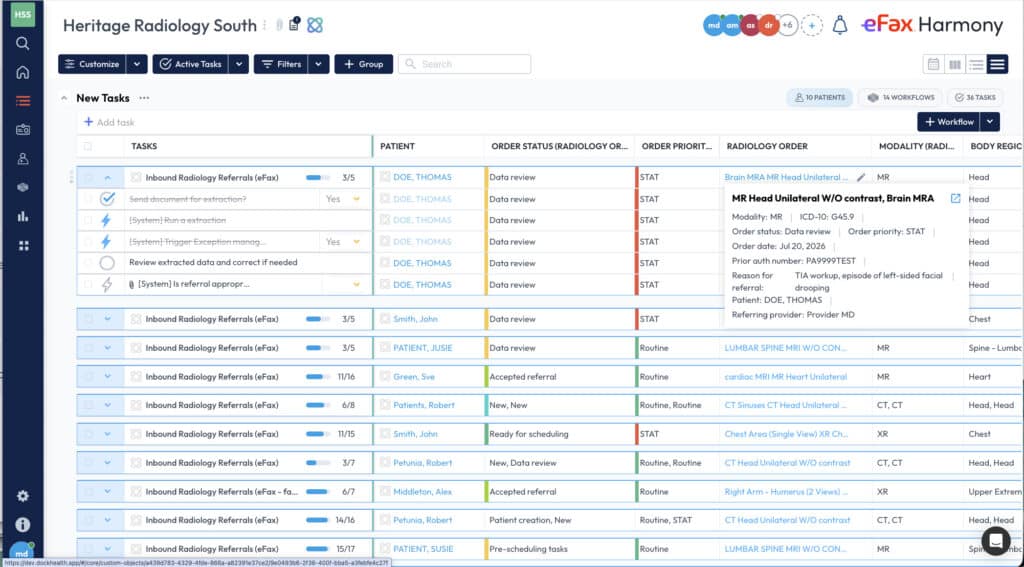
From Clinical Intent to Accelerated Care
Consider a referral. A provider submits clinical intent through a form, fax, phone call or another channel. It arrives, but the work doesn’t end there.
Supporting documentation may be missing. Information may need to be captured or routed. An authorization may need to be initiated. A patient needs to be scheduled. eFax® Harmony helps turn that incoming information into the work required to move the referral forward.
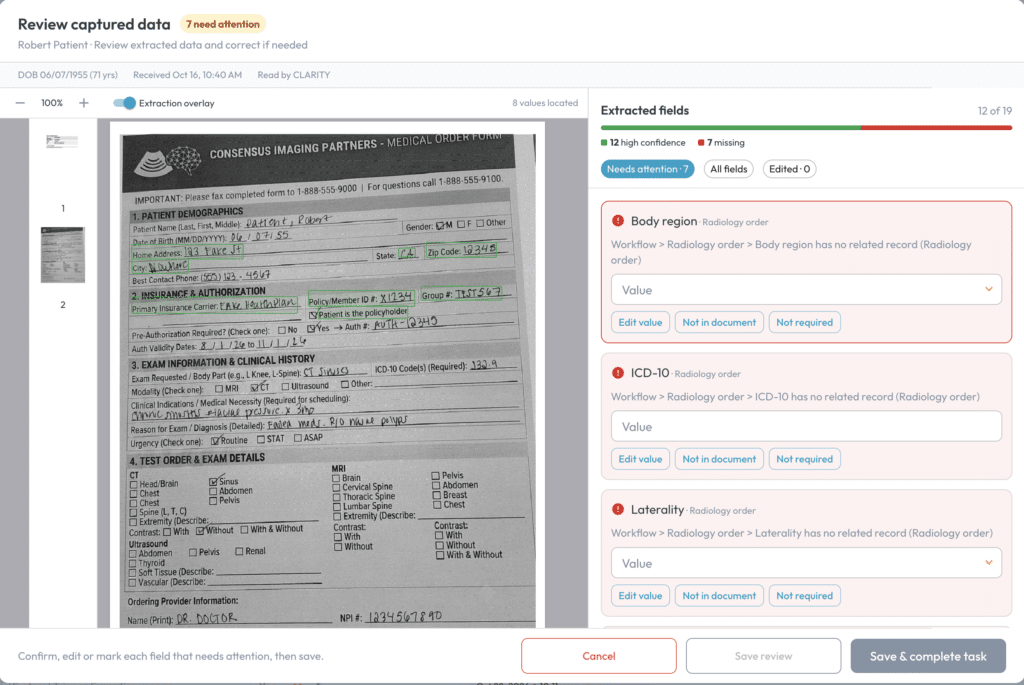
The same principle applies to prior authorizations, medical records, orders, intake and other healthcare workflows where information needs to become action.
Who eFax® Harmony serves
eFax® Harmony is built for the teams responsible for keeping that work moving – from care access and clinical operations to administrative and revenue teams.
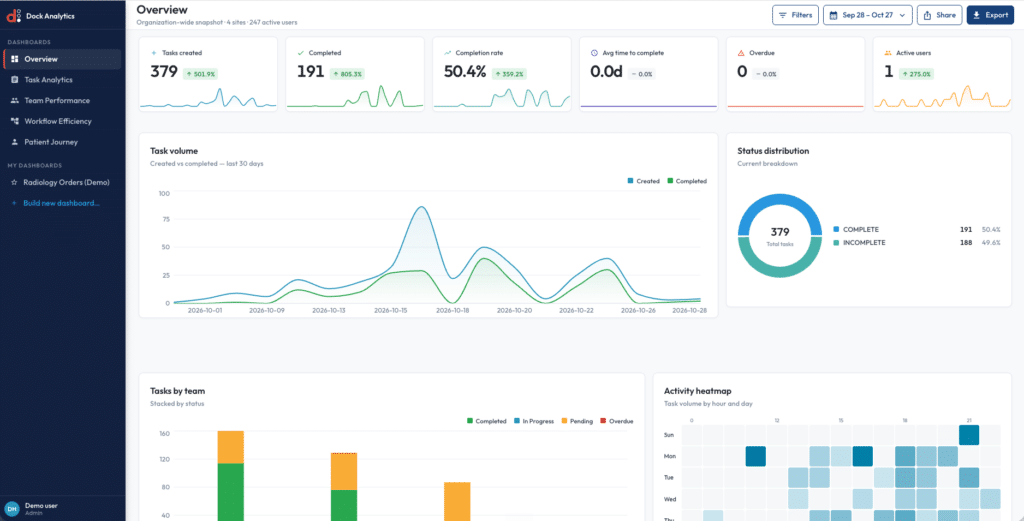
The impact shows up where it matters most: faster time to scheduled care, greater workforce efficiency, better capacity utilization and access, and stronger overall organizational performance.
Why Now?
Healthcare organizations have addressed these problems for decades with spreadsheets and sticky notes. They have invested heavily in EHRs, automation, interoperability and countless point solutions. Yet too much critical work in these clinically adjacent workflows still depends on manual intervention, fragmented processes and people chasing what should happen next.
The pressure to solve it has reached an inflection point.
Research estimates that purely administrative waste accounts for 15% to 30% of total U.S. healthcare spending, a rate that substantially exceeds administrative overhead in other developed nations. Furthermore, according to data from the CAQH Index, administrative transactions alone cost the U.S. healthcare system $60 billion annually, yet transitioning from manual and legacy processes to fully electronic, automated workflows represents an estimated $25 billion (or 41%) annual cost-reduction opportunity.
At the same time, an aging population is increasing demand for care, workforce shortages and burnout are constraining capacity, and patient expectations are rising. Compounded by tightening reimbursement rates that leave most systems running on razor-thin margins, organizations are being asked to do more with less in an environment that can no longer absorb that overhead.
Healthcare cannot simply keep adding headcount, procuring point solutions, and driving up costs just to keep work moving. We need to modernize the infrastructure healthcare already depends on. That means transformation has to do more than improve an experience or automate a task. It has to deliver the measurable operational return that sustains the industry and organization.
The opportunity is to turn the information already flowing through healthcare into completed work – and completed work into greater capacity, access, and performance.
Why eFax® Harmony?
eFax® Harmony brings together capabilities that have traditionally lived across different parts of the healthcare technology stack: trusted information exchange, intelligent intake and workflow orchestration.
Together, they create a unified platform for receiving information from any source, understanding its patient context, identifying what is needed, triggering the right workflow, and helping teams follow it through to completion. And because eFax® Harmony integrates seamlessly with the systems and infrastructure healthcare organizations already rely on, organizations can build on what they have rather than start over.
That gives us a differentiated opportunity: to connect the information exchange healthcare already trusts with the work required to turn clinical intent into completed care. We aren’t replacing the foundation healthcare relies on, we are expanding what that foundation makes possible.
We delivered trust. Now we deliver the efficiency behind better care.
We’re not changing the foundation healthcare relies on. We’re extending what that foundation can make possible.
The information we move, now moves care forward. That’s eFax® Harmony. And this is only the beginning.