Healthcare & Interoperability
Winning the Referral Race: How AI-Powered Intake Transforms Imaging Centers


last updated Updated
December 17, 2025
6 min read

 Healthcare & Interoperability
For imaging centers and radiology groups, competition for referrals is more intense than ever. National quality measures, such as those outlined in the CMS “Closing the Referral Loop” (eCQM CMS50), highlight persistent gaps in referral communication and set explicit targets to ensure the referring clinician receives a specialist report.
In this landscape, success depends not just on clinical excellence but also on operational speed, data accuracy, and the ability to convert each inbound referral into a scheduled, reimbursed procedure with maximum efficiency. Yet, many organizations are limited by manual intake processes that drive up costs and contribute to referral leakage and delayed or incomplete information exchange.
This blog examines the operational and financial stakes of radiology referrals and demonstrates why integrating an intelligent data extraction solution is now business-critical. By automating the conversion of unstructured inbound data into structured, actionable information, imaging centers can strengthen revenue retention, enhance compliance, and achieve measurable improvements in operational control.

The Modern Referrals Battleground: A War of Attrition
The challenge begins the moment a referral is sent. Physicians’ offices still rely heavily on fax, supplemented by a mix of emails and scanned documents. This torrent of unstructured inbound information creates an immediate operational burden. Staff must manually sift through documents, identify patient demographics, rekey data into the EHR or RIS, and route the referral for scheduling and prior authorization.
National quality measures such as CMS eCQM CMS50 confirm that referral workflows often break down due to communication gaps, with incomplete or delayed information leading to further referral disruption.
As a result, organizations face:
- Processing Delays: Every minute spent on manual data entry gives competitors an opportunity to schedule the patient first. Slow intake creates a poor experience for referring providers and patients, increasing the likelihood they will go elsewhere. In fact, the average hospital loses roughly $12.5 million per year from radiology patient leakage – largely due to significant wait times.
- Referral Leakage: Failed referrals for specialty care, including radiology, are common. One study found that only 54% of faxed referrals become scheduled appointments. Lost faxes, misfiled documents, and data entry errors cause referrals to fall through the cracks. This represents a direct loss of revenue and missed opportunity to build stronger referring relationships.
- Increased Denials: 26% of respondents from a 2025 State of Claims report released by Experian Health reveal that one-tenth of denials result from inaccurate or incomplete data collected at patient intake. The subsequent rework consumes valuable staff time and delays patient care, negatively impacting cash flow.
- Operational Inefficiency: Dedicating highly skilled administrative staff to tedious, low-value tasks like scanning and data entry diverts them from critical functions such as scheduling, financial counseling, and provider relations. 73% of radiology departments see improving operational efficiency as their biggest challenge now and in the years ahead, according to GE Data and Market Research.
Integrating AI-enhanced intake that converts unstructured faxes, emails, and scans from document management systems and portal uploads into structured data—routed directly to the appropriate EHR or RIS record—directly addresses these breakdowns and reduces manual intervention. Optimizing the “front door” of your operations—the intake process—is the single most effective way to increase throughput and protect revenue.
The Economics of Optimized Intake
The financial impact of a streamlined referral workflow is significant. Even minor improvements in speed and accuracy yield substantial returns. For example, AI-driven worklist reprioritization in pulmonary embolism (PE)-positive CT pulmonary angiography (CTPA) demonstrated a reduction in mean report turnaround time by 12.3 minutes (from 59.9 to 47.6 minutes) and a 12.0-minute decrease in mean wait time—metrics that translate directly into accelerated scheduling velocity and greater operational capacity.
An efficient intake system boosts scheduled volume by reducing the window for patient or provider drop-off. When your team can process more referrals without adding headcount, you not only reduce operational costs but also increase your capacity for revenue-generating procedures.
This is where intelligent document processing becomes a strategic asset. By automating the extraction and routing of referral data, you transform a cost center into a powerful engine for growth.
Transforming Operations with AI in the Radiology Workflow
An AI-powered clinical documentation solution directly addresses the core challenges of manual intake, operating as an intelligent bridge between unstructured inbound communications and core clinical systems such as the EHR and RIS. The transformation enabled by AI in radiology workflows is increasingly recognized in the literature, with recent multi-institutional initiatives standardizing data quality and privacy to support real-world deployment.
Critically, true operational efficiency is achieved not by alerts or passive notifications alone, but by seamlessly integrating AI-driven reprioritization and automated routing into core systems. Studies show that when AI actively prioritizes and routes structured documents within the reading queue, turnaround time and operational throughput materially improve—whereas notification-only approaches yield negligible effect. This underscores why converting inbound faxes, handwritten notes, and emails to structured formats and directly delivering them to EHR or RIS is essential for measurable efficiency gains.
The Measurable Gains of an Automated System
Implementing an intelligent intake solution delivers measurable operational and clinical improvements across the organization. The benefits extend beyond the administrative department to impact clinical operations, financial performance, and regulatory standing.
A 2024 prospective study in the American Journal of Roentgenology found that integrating AI assistance into radiology workflows increased radiologists’ sensitivity for detecting actionable findings from 80.0% to 96.2%, while maintaining 99.9% specificity. This substantial uplift reduces the number of missed or delayed findings and accelerates downstream care coordination, translating to tangible efficiency for organizations.
So, what does this mean for your organization? For one, reducing manual processes through automated intelligent data extraction and entry minimizes tedious workflow steps, freeing your team to focus on evaluating and caring for patients. Referrals are also processed in near real-time, accelerating the entire cycle from receipt to scheduling and care delivery.
AI-driven extraction also significantly reduces the human error associated with manual rekeying, leading to fewer misfiled patient records and a cleaner database. Fewer errors in patient data and a more organized workflow will ensure that your organization can better adhere to strict state and federal regulations.
Referring providers appreciate a fast, reliable process. Patients benefit from quicker scheduling and fewer administrative hurdles. Your staff experiences less burnout from repetitive tasks. These benefits combine to create an efficient process with fewer errors and leading to higher satisfaction.

Seamless Integration and Effective Change Management
Adopting new technology can seem daunting, but it doesn’t have to be. A key advantage of modern AI-enhanced patient intake solutions is their ability to integrate seamlessly with your existing workflow infrastructure. This means your staff gets the productivity benefits of AI without having to do a large amount of change management.
eFax Clarity uses proprietary AI – natural language processing and machine learning – to revolutionize the fax and document workflow. By integrating AI into your radiology workflow, you convert a chaotic stream of inbound documents into an organized, efficient, and actionable flow of information. It also leverages advanced document classification to automatically identify key document types and can flag critical information, such as imaging modality information or unique procedure codes, for immediate clinical priority review.
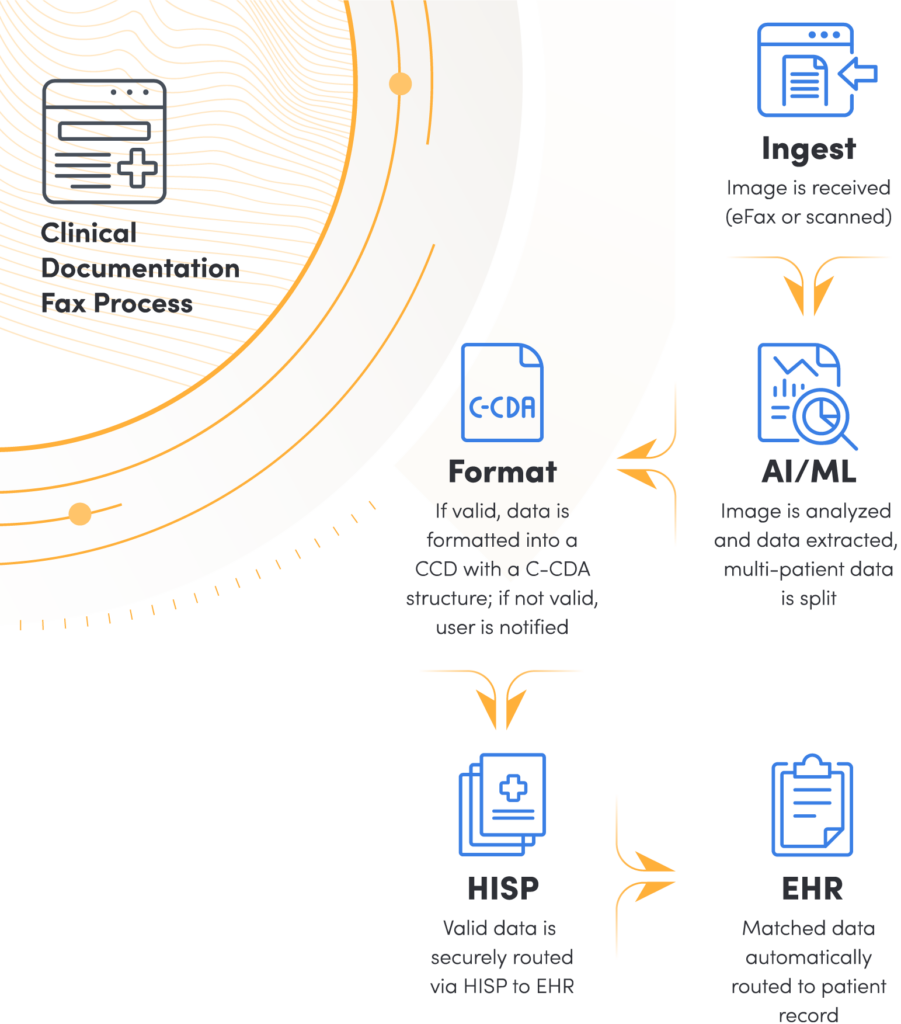
eFax Clarity operates without the need for a separate, standalone platform, minimizing disruption and simplifying change management. This implementation connects directly to your inbound sources and clinical systems, allowing you to spend more time focusing on critical care delivery.
Success can be tracked through clear KPIs, including:
- Time-to-schedule reduction
- Decrease in denial rates related to demographics
- Increase in daily referral processing throughput
- Reduction in unassigned or misfiled documents
These metrics provide tangible proof of ROI and help build momentum for further process optimization.
Optimize Efficiency with Intelligent Intake
With the competitive nature of radiology referrals, operational efficiency is the ultimate differentiator. By eliminating the friction, delays, and errors inherent in manual intake, you can increase throughput, reduce denials, and capture revenue that would otherwise be lost. An AI-powered clinical documentation solution provides the strategic capability to turn your inbound referral process into a secure, scalable, and highly efficient workflow.
Explore how such a powerful solution can help your imaging center extract vital data faster, connect with patients and providers sooner, and administer care with greater efficiency.